An AI-Powered Public Safety Intelligence Platform for Smart State Governance
An AI-Powered Public Safety Intelligence Platform for Smart State Governance integrates real-time incident data, artificial intelligence, and geospatial analytics to support predictive risk assessment, multi-agency coordination, and data-driven decision-making, enabling governments to enhance public safety management, disaster preparedness, and efficient governance for smarter, safer, and more resilient communities.
1/31/20263 min read
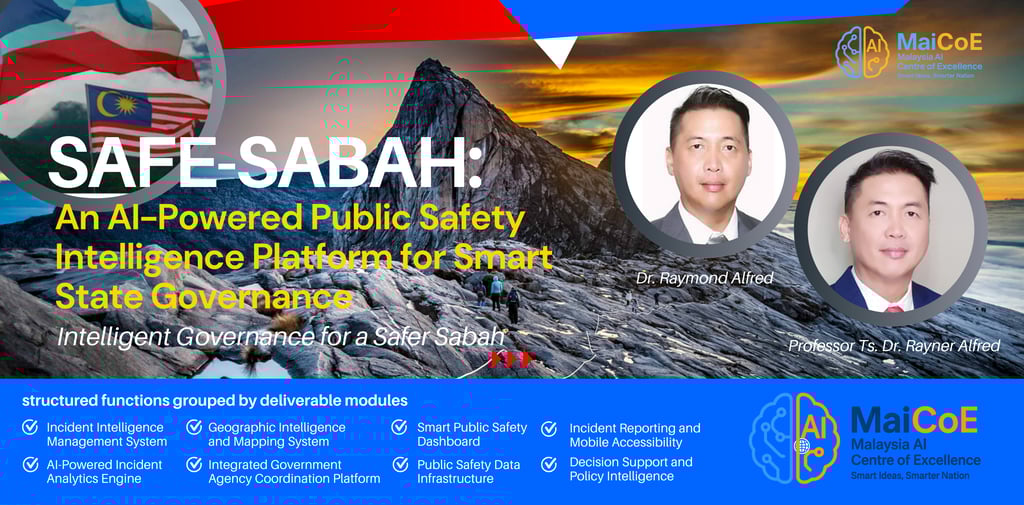

Public safety management in Sabah faces increasing challenges due to fragmented incident reporting systems, limited real-time situational awareness, and insufficient coordination among government agencies. Current approaches are largely reactive and lack integrated intelligence capabilities that enable predictive analysis and data-driven governance. The absence of a centralized platform that combines incident data, geospatial intelligence, and advanced analytics creates a significant gap in supporting efficient emergency response, disaster preparedness, and strategic public safety planning.
This project proposes SAFE-SABAH, an AI-powered Public Safety Intelligence Platform designed to enhance smart state governance through integrated incident monitoring, predictive analytics, and multi-agency coordination. The platform leverages Artificial Intelligence (AI), machine learning, geographic information systems (GIS), and big data technologies to collect, integrate, and analyze incident data from multiple sources, including government agencies, IoT sensors, surveillance systems, and public reports. Through real-time dashboards, geospatial visualization, and intelligent analytics, SAFE-SABAH will provide decision-makers with comprehensive situational awareness and actionable insights for proactive public safety management.
The primary aim of the project is to develop a centralized digital intelligence platform that strengthens incident monitoring, enhances coordinated response among agencies, and supports data-driven policymaking for public safety governance in Sabah. The objectives include developing an integrated incident management system, implementing AI-based predictive analytics, enabling geospatial intelligence for incident mapping, facilitating multi-agency collaboration, and delivering real-time decision-support tools for policymakers.
Key deliverables of the project include an AI-driven incident intelligence platform, predictive analytics models, a GIS-based incident monitoring system, a multi-agency coordination module, and an executive public safety dashboard. These components will form a comprehensive digital infrastructure for monitoring, analyzing, and responding to safety incidents across the state.
The expected outcomes of SAFE-SABAH include enhanced public safety monitoring, faster incident response, improved inter-agency coordination, and stronger evidence-based governance. By integrating advanced technologies into public safety management, the platform will contribute to Sabah’s vision of becoming a data-driven smart state and can serve as a scalable model for AI-enabled safety governance in Malaysia and the broader Southeast Asian region.
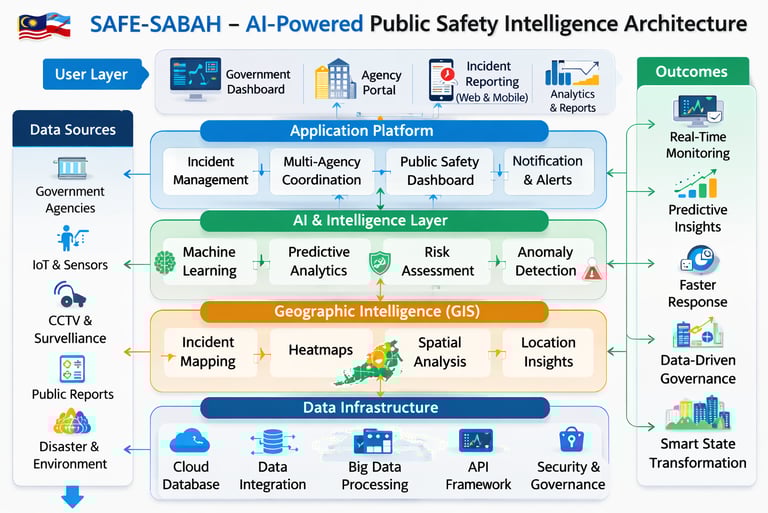
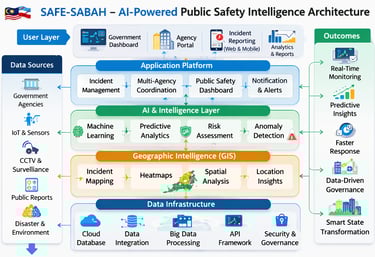
The technical architecture of SAFE-SABAH, an AI-powered public safety intelligence platform designed to support smart state governance in Sabah, Malaysia. The diagram illustrates how the system integrates multiple data sources, advanced analytics, and decision-support tools to enhance public safety monitoring and response. On the left side, various data sources such as government agencies, police and law enforcement, disaster and environmental monitoring systems, health and emergency services, infrastructure systems, IoT sensors, CCTV surveillance, public reports, and social media feeds contribute real-time and historical information to the platform. These data streams are processed through a data integration layer, which includes data collection mechanisms, real-time data streaming, API integration, secure cloud storage, big data processing, and governance frameworks to ensure secure and efficient data management.
At the core of the architecture is the AI and Intelligence Layer, where machine learning models analyze incoming data to detect patterns, predict incidents, assess risks, and identify anomalies. This intelligent layer transforms raw information into actionable insights that support proactive decision-making. The platform also incorporates a Geographic Intelligence (GIS) Layer, which enables spatial analysis through incident mapping, heatmap visualization, location tracking, and geographic risk forecasting across different districts in Sabah. These analytical capabilities feed into the Application Platform, which includes tools such as an incident management system, multi-agency coordination modules, public safety dashboards, notification and alert mechanisms, reporting systems, and mobile access for field officers. The system is designed to be used by policymakers, government agencies, emergency responders, and the public, providing them with real-time situational awareness and operational insights.
Overall, the architecture demonstrates how SAFE-SABAH functions as an integrated digital ecosystem that combines artificial intelligence, big data, and geospatial technologies to support predictive monitoring, faster incident response, and coordinated governance. By enabling data-driven decision-making and improved collaboration among agencies, the platform aims to strengthen public safety management and contribute to the development of a smart, resilient, and digitally empowered state for Sabah and Malaysia.
by Professor Ts. Dr. Rayner Alfred
Technical Architecture (AI-Data- Platform)